

On this page
SPF lists the servers that may send for your domain. DKIM signs each email. But neither one, on its own, looks at the address people actually see in their inbox, and neither tells the receiving server what to do when a check fails. That is DMARC's job.
DMARC ties SPF and DKIM to your visible From address, lets you decide what happens to email that fails, and sends you reports about everyone sending in your name. This guide explains how it works, what alignment means, and how to tighten your policy without sending your own emails to spam.
What is DMARC?
DMARC (Domain-based Message Authentication, Reporting and Conformance) is a short TXT record published at _dmarc.yourdomain.com. It does three things:
- It checks alignment. An email passes DMARC only if SPF or DKIM passes for the same domain as the From address the reader sees.
- It sets a policy. You decide what receivers do with email that fails: deliver it anyway, send it to spam, or reject it.
- It sends reports. Inbox providers send you a daily summary of every server that sent email as your domain, and whether it passed.
Without DMARC, anyone can send an email showing your domain in the From line, and the receiving server has to guess whether it is genuine. With DMARC, you tell it.
How DMARC works
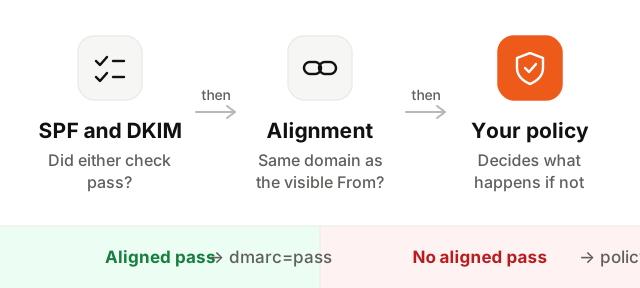
- 1The email arrives and is checked. The receiving server runs SPF and DKIM as usual.
- 2It reads your DMARC record at
_dmarcon the domain of the From address. - 3It checks alignment. Did SPF pass for a domain matching the From? Did DKIM pass with a signature (
d=) matching the From? One aligned pass is enough. - 4It applies your policy. With an aligned pass, the email passes DMARC. Without one, your policy decides:
none,quarantineorreject. - 5It reports back. The result is added to the daily report sent to the address in your record.
What is DMARC alignment?
Alignment is the part of DMARC that trips people up most, and the one that makes it useful.
An email has several domains in it. The From is what the reader sees. The Return-Path, checked by SPF, is often your sending service's domain. The DKIM signature carries the domain that signed it in d=. A spammer can pass SPF and DKIM for their own domain while showing yours in the From. Alignment closes that gap: the domain that passed has to match the From.
By default, alignment is relaxed: news.acme.com aligns with acme.com, because they share the same organizational domain. With strict alignment (adkim=s or aspf=s), only the exact same domain counts.
What does a DMARC record look like?
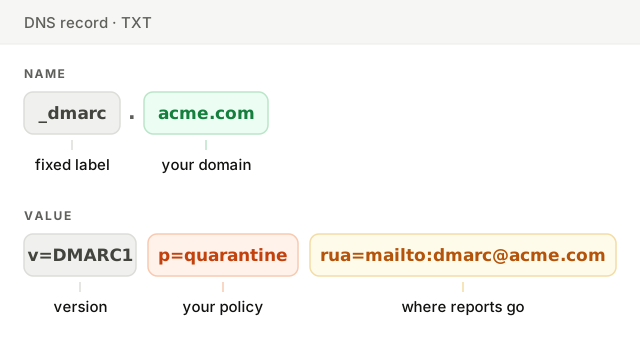
| Tag | What it means |
|---|---|
v=DMARC1 | Marks the record as DMARC. Always first. |
p= | Your policy for the domain: none, quarantine or reject. Required. |
rua= | Where daily summary reports are sent, like mailto:dmarc@acme.com. Always set it. |
sp= | A different policy for subdomains. Without it, they follow p=. |
pct= | Applies the policy to a percentage of failing email, for a gradual rollout. |
adkim= / aspf= | Alignment for DKIM and SPF: r relaxed (default) or s strict. |
ruf= | Where reports on individual failures go. Few providers send them. |
DMARC policies: none, quarantine and reject
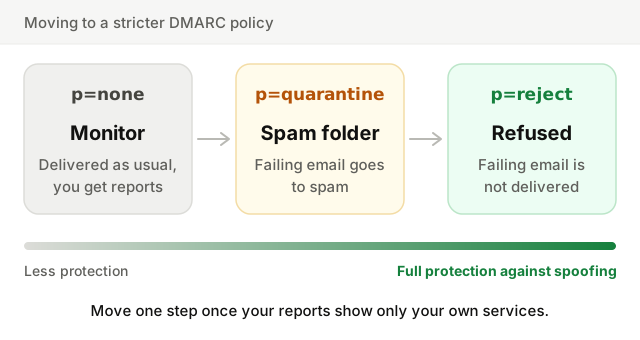
p=noneis monitoring mode. Failing email is delivered as usual, and you receive reports. It is where everyone should start, and it is enough for the Gmail and Yahoo sender rules. But it does not stop anyone from spoofing your domain.p=quarantinesends failing email to the spam folder. A good middle step once your reports show that your real services all pass.p=rejecthas failing email refused outright. The strongest protection against phishing in your name, and the goal for most domains.
How to set up DMARC
- 1Make sure SPF and DKIM are in place for every service that sends as your domain, with DKIM signing for your own domain.
- 2Publish a monitoring record. Add a TXT record named
_dmarcwith a value likev=DMARC1; p=none; rua=mailto:dmarc@yourdomain.com. - 3Read the reports for a few weeks. They are XML files; a DMARC report service turns them into something readable. Look for servers you do not recognise and services that fail alignment.
- 4Fix every legitimate service that fails. Usually by setting up DKIM with your domain, or a custom Return-Path for SPF.
- 5Tighten step by step. Move to
p=quarantine, optionally withpct=below 100 at first, then top=rejectonce only your own services show up.
If reports go to an address on another domain (a report service, for example), that domain has to publish a small record authorizing it, otherwise receivers will not send the reports. Report services set this up for you.
How to check your DMARC record
Enter your domain below. The checker finds your DMARC record (or the one your subdomain inherits), reads your policy and explains every tag.
On a real email, show the original message: the Authentication-Results header contains dmarc=pass or dmarc=fail, with the policy that was applied and the domain of the From.
Common DMARC mistakes
- Staying on
p=noneforever. It satisfies the sender rules but protects nothing. Use it to learn, then move on. - No
rua=address. Without reports, you cannot see what would break before you tighten your policy. - Going to
p=rejecttoo fast. A service you forgot, like an invoicing tool or a help desk, starts landing in spam or bouncing. Read the reports first. - Two DMARC records. Receivers ignore DMARC entirely when there are two. Keep one.
- Relying on SPF alone. SPF often passes for your provider's domain, not yours, and breaks when email is forwarded. Aligned DKIM is what keeps DMARC passing.
- Forgetting subdomains. They inherit the parent's policy unless
sp=says otherwise. A strict policy on the parent applies to a subdomain you send from too.
SPF, DKIM and DMARC: the full picture
SPF says which servers may send. DKIM proves each email is genuine and unchanged. DMARC checks that either one passed for the domain people actually see, decides what happens when they do not, and reports back. Together, they are what Gmail, Yahoo and Outlook expect before trusting your email.
Check all three at once, and whether you meet the Gmail and Yahoo rules, with the Deliverability Setup Checker.